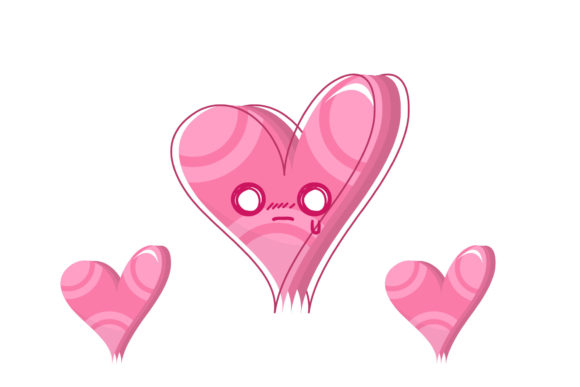
Kawaii Heart Decorative Element Design: Graphics & Illustrations
As someone who’s shipped over 3,000 custom mugs, designed seasonal sticker bundles for Etsy, and cut vinyl for craft fairs since 2018—I opened Kawaii Heart Decorative Element Design with high expectations. And honestly? It delivered that sweet spot of playful charm and clean usability I look for in a graphic design asset meant for real handmade business use.
This isn’t just “cute”—it’s intentionally kawaii: soft curves, gentle blush tones, subtle shine details, and a heart shape that feels both nostalgic and fresh. It leans feminine without being saccharine, joyful without sacrificing polish. Think customers browsing your Etsy shop for birthday party favors, planner lovers adding whimsy to their weekly spreads, or gift shoppers seeking heartfelt yet modern thank-you cards. It speaks to buyers who love personality *and* precision—exactly the audience handmade sellers want to attract.
How I Actually Used Kawaii Heart Decorative Element Design Across My Product Line
In my latest spring collection, I tested this illustration across six physical product types—all within one week:
- Cricut project: Cut as a layered vinyl decal (using the SVG) on pastel ceramic mugs—held up beautifully after dishwasher testing.
- Sticker design: Resized the PNG (with transparent background) for 2” kiss-cut stickers—printed crisp on matte sticker paper with no halo or pixelation.
- Tumbler wrap: Paired it with a coordinating script font in Cricut Design Space to create a reusable tumbler sleeve mockup—ideal for Instagram product previews.
- Printable design: Added it to a set of 5x7” gift tags (PDF), scaled to 1.25” height—balanced well with hand-lettered text and left breathing room.
- Sublimation design: Imported the high-res PNG into my sublimation software at 300 DPI—no jagged edges on polyester tote bags.
- Small business branding: Used the AI file to extract the heart outline and turned it into a minimalist logo lockup for my packaging tape.
Where This Graphic Design Asset Shines—and Where to Proceed Thoughtfully
It works best when:
- You’re building a seasonal craft bundle—especially for Valentine’s Day, baby showers, or self-love-themed planner kits.
- You need a decorative accent that doesn’t overwhelm: think corner embellishments on printable wall art or subtle repeats in scrapbooking papers.
- You're designing product mockups for your Etsy listings—the 1920px × 1280px canvas gives plenty of working space without upsampling strain.
- You're pairing it with serif fonts for elegant greeting cards or sans-serif fonts for clean, modern t-shirt designs.
- You’re creating digital products like Canva-editable planners—its transparency and resolution hold up across platforms.
Use carefully when:
- Cutting tiny versions (under 0.75”)—the inner highlights and subtle gradients lose definition on small vinyl cuts.
- Layering multiple colors in vinyl—this design has soft shading; avoid stacking unless you’ve tested alignment on your machine first.
- Printing on dark substrates without a white underbase—the blush tones fade slightly on navy or charcoal unless prepped properly.
- Using only the PNG for intricate Cricut projects—always check the SVG lines in Design Space for stray nodes or overlapping paths.
- Assuming all six files are print-ready at any size—while the resolution is strong, scaling beyond 200% may soften fine details.
Practical Crafter Notes You’ll Wish You Had Before Your First Batch
I learned these the hands-on way—so you don’t have to:
- Always test before selling: I ran a single mug, one sticker sheet, and a 4” sublimation swatch before committing to a full run. Saved me from color mismatches and cut errors.
- Preview transparency early: Open the PNG in Photoshop or GIMP—not just your browser—to confirm the background is truly transparent (no hidden white pixels).
- Check commercial licensing: Yes, this is licensed for commercial use—but verify whether attribution is required if you’re bundling it into a larger design sold on Creative Market or your own site.
- Resize smartly: For Cricut projects, scale using percentages (not inches) to preserve proportions. For printables, always re-export at 300 DPI after resizing.
- Pair intentionally: This heart sings next to rounded sans-serifs (like Quicksand) or delicate scripts (like Great Vibes)—but clashes with bold display fonts unless used sparingly as an accent.
- Mock it up in context: Drop it onto a real product mockup (I use Placeit) before listing—seeing it on a kraft gift tag versus a glossy sticker changes everything.
Why This Fits Real Handmade Business Needs—Not Just Hobby Projects
Kawaii Heart Decorative Element Design isn’t just clipart—it’s a versatile illustration built for scalability, brand cohesion, and production efficiency. As a handmade business owner, I value assets that reduce my design-to-fulfillment time without sacrificing uniqueness. This one lets me pivot fast: same heart, different application—mug today, planner sticker tomorrow, sublimated tote bag next week.
It also supports consistent small business branding. Because it comes with an AI file, I extracted vector paths to build matching social media icons and email headers. That kind of flexibility—across Cricut projects, Silhouette projects, printable designs, and digital products—is rare in single-illustration graphics.
If you sell on Etsy, prep for craft fairs, or supply local boutiques with handmade goods, this graphic design asset earns its place in your toolkit. It’s not flashy—but it’s reliable, charming, and quietly professional. And in handmade business? That’s the gold standard.